DSB
The legend of Sikh sacrfices in world conflicts
When you go home tell them of us, and say, for your tomorrow, we gave our today.
The image of the Sikh is so powerfully distinct, that no matter where they have gone, they have portrayed what Guru Nanak intended to make them – saints and soldiers. Where you see a Sikh in meditation, the same saintly soul is blessed with the ability to fight in the thick of the battlefields. No other peoples have such an indenity which depicts the very quality of their founder Gurus and their GurSikhs.
In the following essay, the intention is to highlight a heritage that will forever live in the Sikh spirit – soldiers of the highest discipline and courage who are ready to lay down their lives in the name of the Guru’s message of upholding righteousness. Guru Arjan Dev Ji began the endless legacy of the ultimate sacrifice which only the Sikhs are known to give in the highest numbers, for any government or power under which they serve in complete loyalty. In the images, you can see the Guru in these fearless soldiers. They carry the roop of the Guru and fight unto death to preserve the honour of the Guru’s identity. Those that have broken off from this identity for feeble excuses of the mind cannot compare to what these great Sikhs have given to preserve the gift of the Guru even in the midst of life and death. It’s a heritage Sikhs will ever own, for that is their Gurus’ blessing to them . . .
By Vicky Singh
Sikhs primarily come from the Punjab, a province of Northern India. Sikhs are one of the most visible minorities. With his beard and turban, a Sikh can be identified in any crowd. Still they are perhaps the least understood as a people. Not many people know about the beliefs, practices and ethics of the Sikhs, and still fewer will understand their significance. Right from the ancient period of the Indus Valley civilization (3000 BC), the Punjab has played a significant role in the history of India. Its geographic location makes it the gateway of India from the northwest. All through the ages, the fertility of its plains became the cause of its wealth as also the reason for many invasions. Hardened with the extremes of climate that exist in the region, it soon became the birthplace of a war-like people. The Sikh religion originated in India in the fifteenth century.
Guru Nanak, the founder of the religion, preached oneness of God and brotherhood of man. At that time Hinduism and Islam were the predominant religions in India; and relations between the two communities were not good. Guru Nanak preached dignity of man and tolerance for the viewpoint of others: “The World is burning, O Lord, Save it, O Save it, by whichever door it pleases thee. ”
Guru Nanak was followed by nine successor Gurus, followed by the Holy Scriptures, Guru Granth Sahib which was ordained as the Guru of the Sikhs. In Sikh thought, the Word (contained in the Granth Sahib) is the Guru. During the eighteenth century, Sikhs suffered great persecution at the hands of the local rulers, but by the end of the eighteenth century they had established their rule in northwest India.
By the middle of the nineteenth century, the kingdom collapsed, and it was incorporated into British India. After some time the relations between the Sikhs and the British improved, and they joined the army in great numbers. The valor of Sikh soldiers during the two world wars was internationally recognized. Most people associate the Sikhs with the army and sometimes with violence. This is a very inaccurate picture and misleading.
As the allied nations stepped closer to the second global conflict, this time with the Imperial Japanese and the Germans, Sikh soldiers once again stepped forward and became the back bone of the British Indian Army. Despite the rising voice of independence from the British, in India during WWII, Sikhs still made the majority of the forces that India gave to the war effort. India entered the war when the then viceroy of India, Lord Linlithgow, without consulting Indian leaders, declared war against Germany on behalf of India. There was widespread violence in many cities all across India as British quelled demonstrations that would finally lead to end the British rule in India.


However, states like the Punjab from where the concentration of recruits into the British army came, looked curiously at the events. With only voluntary recruitment into the army, young Sikh men helped to swell the Indian army from 189,000 at the start of the war to over 2.5 million at the end of the war. Those Indians, who secretly supported the Germans, were shocked on 7 December 1941 to know that the Imperial Japanese Air Force had launched an attack on the American Navy at Pearl Harbor.
As Japan entered the war, it started to drive the colonial armies of the Dutch, French, and the English out of Hong Kong, French Indo-China, Philippines, Thailand, and Burma down to Singapore. The 11th Sikh regiment played a major part in the war to route Japan from its hold in South East Asia. Ironically it was the British led Sikh soldiers who had fought in the Anglo-Burmese war of 1882 and 1886 and had helped to annex Burma for the British Empire.
By the eve of the Second World War, Sikhs had fought on the mountains of Afghanistan, the deserts of Africa and the trenches of Flanders. By 1944, Sikh soldiers were well entrenched in the sweltering swamps of Burmese jungles. The Japanese, better suited and well motivated were strongly pushing westward to the plains of India. At the battle of Kohima, Burma, 15th Sikh regiment headed by Naik Gian Singh was facing defeat. As the merciless machine gun shots from the Japanese foxholes burst from the bush, Gian Singh pushed forward with his men behind him, he ordered his men to cover him as he single handedly cleared foxhole after foxhole. Despite being severely wounded, he continued to push through the intense fire and clearing a strategically vital road. The Japanese were forced to retreat.

Gian Singh received the Victoria Cross, the highest order of gallantry in the British Army, at the end of the war. Today in the Kohima cemetery, among the 1,378 grave markers, is the famous Kohima memorial with its historic inscription:
When you go home tell them of us, and say, for your tomorrow, we gave our today.
Over 138,000 Sikh soldiers fought in Belgium and France during World War I. More than a quarter of these soldiers became casualties. In the first battle of Ypres at Flanders in 1914 a platoon of Sikhs died fighting to the last man, who shot himself with his last cartridge rather that surrender.
After the bloody battle of Neuve Chapelle in 1915 the Sikh regiments had lost 80% of their men. The following is a letter sent home by a Sikh soldier:
Thousand and hundreds of thousands of soldiers have lost their lives. If you go on the field of battle you will see corpses piled upon corpses, so that there is no place put hand or foot. Men have died from the stench. No one has any hope of survival, for back to Punjab will go only those who have lost a leg or an arm or an eye. The whole world has been brought to destruction.-Warrior Saints


When the first World War broke out in 1914, there were six battalions of the Sikh Regiment forming part of the British Army. They were named as 14th Ferozepur Sikhs, 15th Ludhiana Sikhs, 35th Sikhs, 36th Sikhs, 45th Sikhs and 47th Sikhs. Since Sikh soldiers were known for their bravery, the British employed all their battalions, except the 35th Sikhs, for fighting at such far-away places like Egypt, Palestine, Mesopotamia, Gallipoli and France.
In all the battles in which they fought, they had to suffer heavy causalities. However, there was no wavering among them and they always stood like rock. The battle of Gallipoli was fought to capture Constantinople so as to reach the Turkish land, who had entered the war scene on the side of Germany. The 2nd Royal Fusiliers were finding it difficult to fight the Turks so the regiment of Sikhs was sent for their help. Although the allies did not succeed, the bravery shown by the Sikhs during this operation became a glorious chapter in the history of warfare. The task given to the Sikhs was highly dangerous. They were to capture two Turkish Trench lines named as J-11 and J-13.
The brave soldiers of 14th regiment Sikhs were equally divided for the task on these two lines. The fierce battle took place on 3rd and 4th June, 1915, wherein the brave soldiers of 14th Sikhs lost 371 men . Gen. Sir Ian Hamilton was the General at that time. When Hamilton landed on April 25 at the Southern Tip of the Gallipoli Peninsula, he found that their strength as compared to that of the Turks was highly inferior. He also realized that the terrain greatly favored the Turks, who were well dug-in. He had made the 14th Sikhs of the Indian Brigade a part of his expeditionary force. Sir Hamilton wrote to the Commander-in-Chief in India:
In spite of the tremendous losses there was not a sign of wavering all day. Not an inch of ground was given up and not a single straggler came back. The ends of the enemy’s trenches were found to be blocked with the bodies of Sikhs and of the enemy who died fighting at close quarters, and the glacis slope was thickly dotted with the bodies of these fine soldiers all lying on their faces as they fell in their steady advance on the enemy. The history of Sikhs affords many instances of their value as soldiers, but it may be safely asserted that nothing finer than the grim valor and steady discipline displayed by them on the 4th June has ever been done by soldiers of the Khalsa.
-Martial India, F. Yeats-Brown, 1945


The brave Sikhs, who earned a very high degree of appreciation included Sardar Udai Singh, who had saved the life of 2nd Lt R.A. Savory. The handsome Sikh was over 6 ft tall and had a fair beard and light green eyes. He was a wrestler from his very childhood and when in 1907 he went to take part in a wrestling match in a nearby village, he was selected by the British to join the 14th Sikhs. He was with the unit when Hamilton’s forces landed at the Gallipoli Peninsula. It is interesting to note that when after the war, he was offered a gallantry award, he pleaded that he should be allowed to go back to his village so that he could pursue his wrestling which was dear to his heart.
Another prominent Sikh soldier associated with this battle was Bhola Singh. When Lt. Gen. Sir Reginald Savory came to India in 1968 to attend the presentation of colors ceremony, Bhola Singh was also present on that occasion. Remembering the past, the General spoke about the close relationship between officers and his men. In his own words:
Only this morning (8th February 1968) Lance Naik Bhola Singh of the 14th Sikhs, who had been wounded in Gallipoli in 1915, took the trouble to come all the way from his home to call upon me, and after 52 years we saw each other again. I was deeply touched, not only at having the pleasure of seeing him again, but also at the thought of all the trouble he had taken to come and see me. When he was wounded, he and I were both young men. Now he is a ‘chitti dari wala’ (white bearded man) and I am old and bald, but although we have both grown much older, yet our affection for each other and our mutual pride in our old Regiment stays as young as ever. Long may this continue. Wahe Guruji Ka Khalsa, Wahe Guruji Ki Fateh.
-Martial India, F. Yeats-Brown, 1945


In August 1914, as the German Army advanced through France and Belgium, more Allied troops were desperately needed for the Western Front. The Indian Army, 161,000 strong, seemed one obvious source of trained men.
In October, shortly after they arrived, they were introduced into some of the fiercest fighting around Ypres. Losses were heavy. The average Sikh battalion had 764 men when it landed; by early November Sikhs had only 385 men fit for duty. The fighting came as a shock to soldiers who were more used to colonial warfare.
One man wrote home “this is not war; it is the ending of the world“. The troops were taken out of the line and rested in early 1915, but were soon back in the trenches, and involved in the heaviest fighting.
The Sikh Corps provided half the attacking force at the Battle of Neuve Chapelle. Morale seemed to pick up in the spring of 1915, only to decline towards the end of the summer, when it became clear that an end to the war was not in sight. The Sikhs again took heavy losses at the Battle of Loos in September. The two Indian infantry divisions were withdrawn from France in December 1915, and sent to Mesopotamia. They were moved because their morale was fragile, and it was thought unwise to expose them to another winter on the Western Front.


The Sikh Army fought in every major operation during World War I. Letters home from soldiers on the Western Front offer extraordinary insight into their feelings about the conflict and impressions of European culture. In the last two world wars 83,005 Sikh soldiers were killed and 109,045 were wounded. They died or were wounded for the freedom of Britain and the world and during shell fire, with no other protection but his turban, a symbol of the Sikh faith.


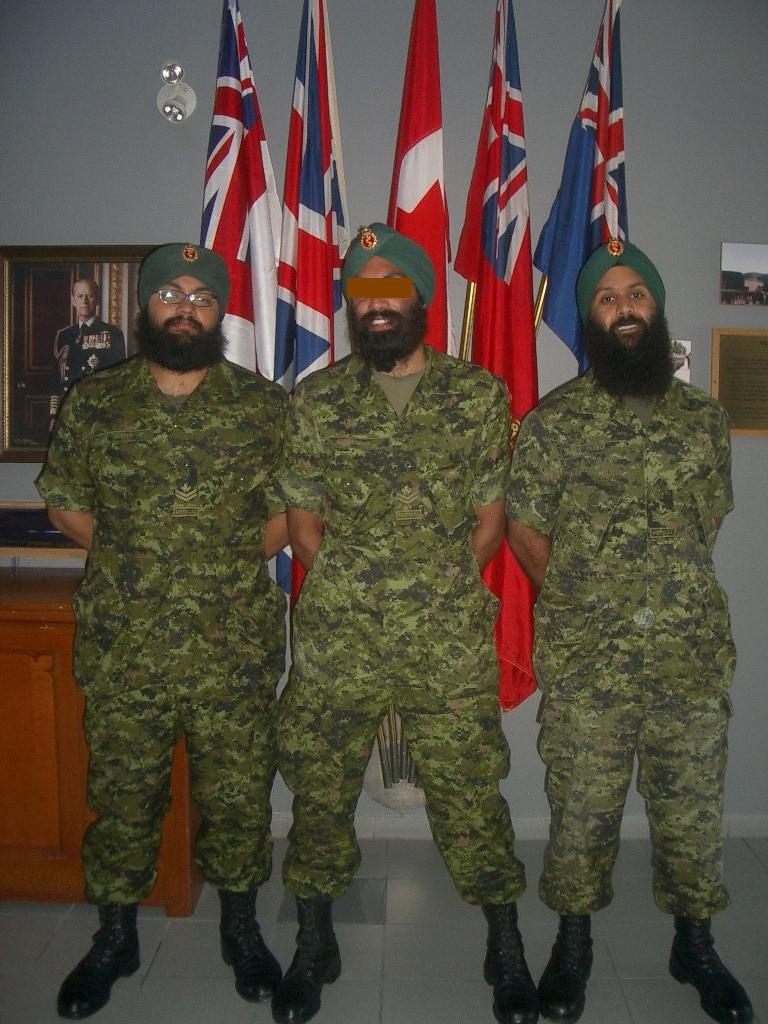


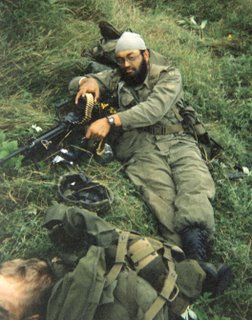 Usually I tie a small dastar and wear a helmet on top. If I’m doing a lot of activity I’ll tie a patka.

